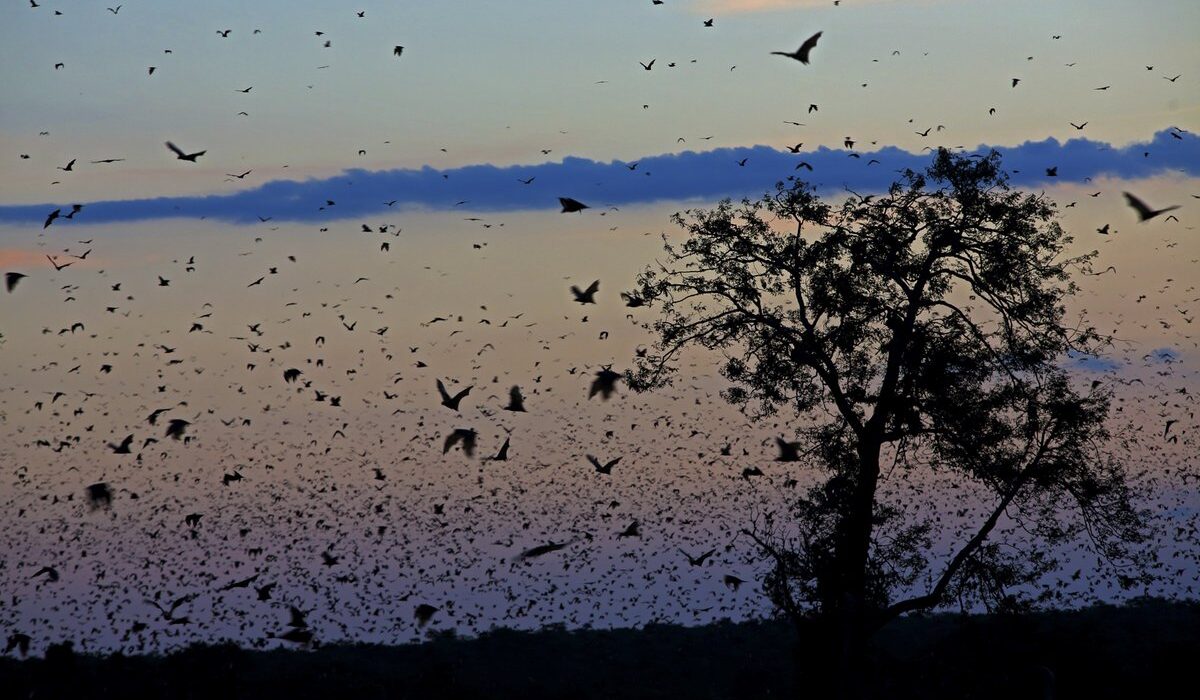
Towards the end of 2025 I was very happy to find out that I am among the 15 artists selected by Musikfonds for their amazing Artificial Intelligence Scholarship Programme. My project explores how non-human group intelligence can inform the design of algorithmic agents for musical co-improvisation. I’ll look at several non-human group behaviours, including how bees use sound to communicate, how large groups of bats use ultrasonic calls to detect their surroundings, and how fireflies synchronise.

Central to the project is the Sophtar, a musical instrument I designed that has been at the centre of my research and practice for the past two years. The Sophtar is an electroacoustic feedback string instrument. The transducer inside its headstock can be used to make its strings vibrate continuously at specific frequencies. The intensity and frequencies at which the strings vibrate can be influenced through custom controls, as well as through algorithms running on the computer embedded in the instrument. In addition to feedback, algorithms can access electromechanical actuators to hit the strings.
The Sophtar will act as a boundary object, a place of encounter between co-improvising algorithmic agents and human performers.


Listening to technology itself
In broader terms, I see studying the dynamics of group behaviour and improvisation as a way to resist, escape, and find alternatives to some of the current polarising mainstream narratives on artificial intelligence. I resonate with the sentiment expressed by the artist and writer James Bridle, who sees artificial intelligence
“not as something which overrides and supplants our own agency, but as something which might bring us to an accommodation with the intelligence and agency of other beings, non-human and more-than-human. Perhaps this is AI’s political role too: to warn us of the dangers of trying to segregate and oppress other beings and to point us towards a better path. […] Placing solidarity at the heart of our relationship with technology is part of this shift in attitudes. It means listening to technology itself, when it tries to tell us something about its uses, affordances and actual outcomes.”1
Resisting corporate narratives
As part of the Wilding AI collective, I promote a view of generative AI in the arts that resists dystopian-utopian binaries and corporate imperatives to instead make space for collectively developing more diverse AI imaginaries2. AI systems with a potential “wildness”—an agentic alterity that functions as a collaborator in the production of novel creative work. Systems “that can be free—if not to imagine then to generate—speeding through possibilities, junctures that are idiotic until they are not”3.
I subscribe to the view that improvisation is a mode of knowledge, critical dialogue, and collaboration across diverse domains4. Improvising can be a way of getting to know that alterity—that “wildness”—that may lie within artificial agents and machine learning models.
Soon at the Centre for the Advanced Study of Collective Behaviour
I will develop the algorithms and models in collaboration with several international laboratories currently carrying out research on artificial intelligence from different perspectives. My first research residency will begin next week at the Centre for the Advanced Study of Collective Behaviour (CASCB) in Konstanz, Germany. There, I will be hosted by the Group Intelligence and self-Organisation lab. I am grateful to the research group leader Andreagiovanni Reina for the invitation, and I look forward to meeting him and the other researchers at the centre. On Wednesday I’ll give a short seminar about my work, part of the Short Cyber-Physical Seminars series.

Since December last year, most of the time I dedicated to the project involved work on establishing collaborations, planning trips for the residencies, budgeting, sourcing materials, and developing the artistic vision further.
In Berlin, I am very excited to be working with multimedia artist and technologist Jonas Margraf and designer and mechanical engineer Aaron Verlooy.
The project will continue throughout 2026 with more artistic research residencies, development work, performances, and a public workshop/symposium.
[I wrote this while listening to Eliane Radigue‘s beautiful Feedback Works 1969-1970.]
Next: Residency at the Centre for the Advanced Study of Collective Behaviour