Tag: event

  • Embedding Algorithms 2

    Embedding Algorithms 2

    algorithmic practices in music and sound

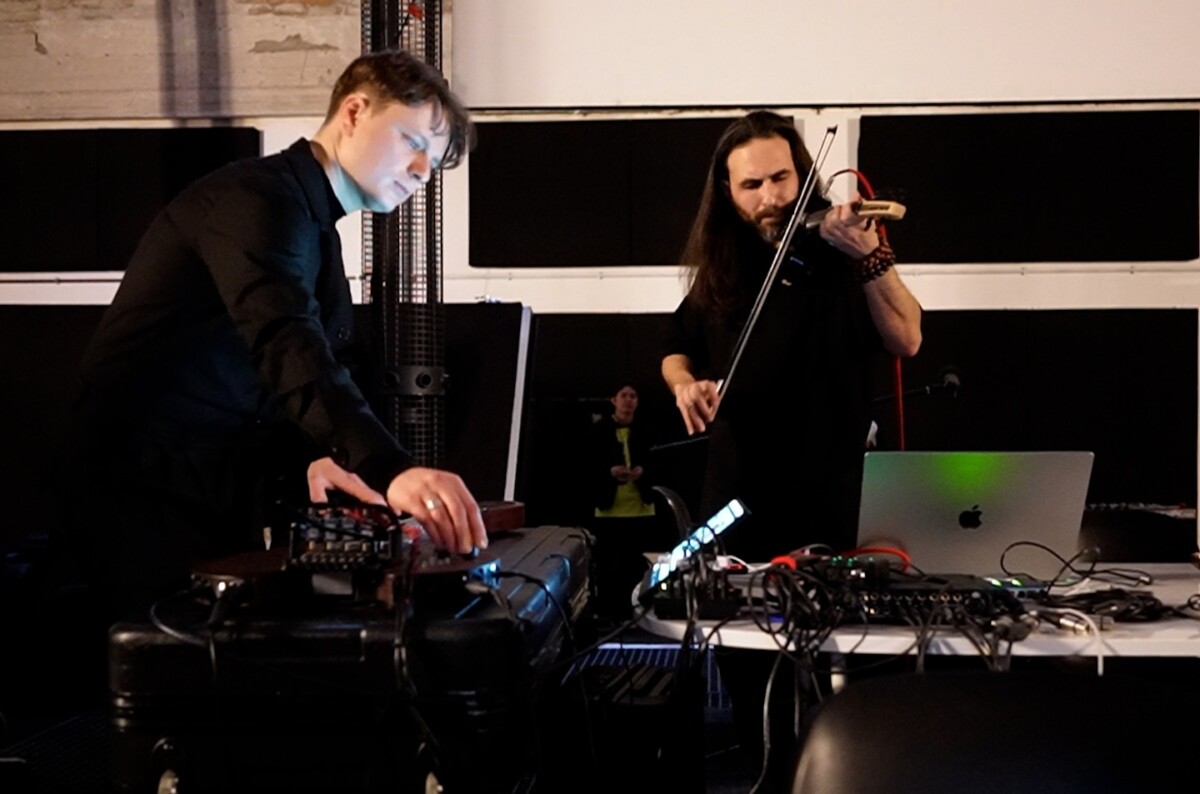
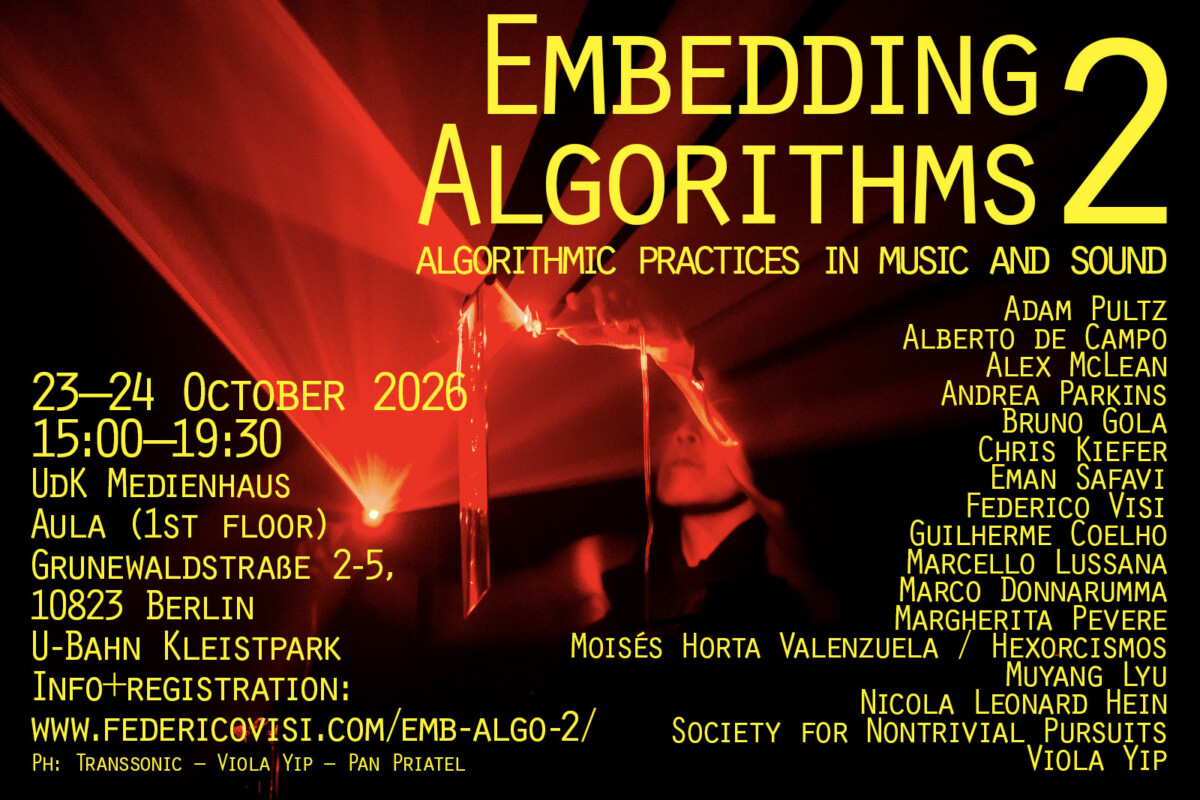
    Embedding Algorithms 2 brings together artists, musicians, and researchers whose work places algorithms at the core of sonic practice. Over two afternoons at UdK Medienhaus, talks and performances will look at how machine learning models, live-coded patterns, biological data, analogue artificial neurons, and feedback circuits become part of how we build instruments, compose, perform, and listen. Topics range from neural audio synthesis and embodied machine learning to neuromorphic computing, art made with living organisms and genetic data, and the politics of training data, alongside spatial sound on the NTSS, a 30-loudspeaker system housed at the Medienhaus.

    The event follows the first Embedding Algorithms Workshop, held at Berlin Open Lab in 2024, and is organised by Federico Visi as part of the project Co-improvising with the Non-human, supported by the Musikfonds AI scholarship (STIP-5). It is kindly supported by the Medienhaus and the Generative Art / Computational Art class at Universität der Künste Berlin.

    Admission is free and open to all.
    The event will be live-streamed.

    If you would like to attend, please register here to receive further information and receive the live streaming links for remote attendance: https://docs.google.com/forms/d/e/1FAIpQLSdge50bUWQwy3mhDmKh3HbjvV6bJ_gSGpMLh7xjrGT2lRqtWw/viewform?usp=publish-editor

    Please register even if you plan to attend in person: it helps us estimate how many people to expect and organise the space accordingly.

    When/Where

    23—24 October 2026
    15:00—19:30
    UdK Medienhaus
    Aula (1st floor)
    Grunewaldstraße 2-5,
    10823 Berlin

    U-Bahn Kleistpark
    Info+registration:
    www.federicovisi.com/emb-algo-2/

    Participants

    Adam Pultz
    Alberto de Campo
    Alex McLean
    Andrea Parkins
    Bruno Gola
    Chris Kiefer
    Eman Safavi
    Federico Visi
    Guilherme Coelho
    Marcello Lussana
    Marco Donnarumma
    Margherita Pevere
    Moisés Horta Valenzuela / Hexorcismos
    Muyang Lyu
    Nicola Leonard Hein
    Society for Nontrivial Pursuits
    Viola Yip

    Short summaries

    Adam Pultz
    Machine Temporalities: The aesthetics and politics of decelerated machine learning
    Since the deep learning revolution in 2012, model size and compute power have followed an exponential growth curve, a feature echoed in the socio-political domain through the fascinating and disturbing project of accelerationism. In this talk I discuss how the artistic use of decelerated machine learning may trouble accelerationist ideology and present a way of speculatively imagining futures beyond technocapitalism.

    Alex McLean
    Non-scribal algorithmic music
    Algorithmic music can feel like abstract, ‘paper rhythms’, which unlike instrumental music, can feel unrelateable to movements of the body. In this talk/performance I’ll share how learning some of the algorithmic patterns underlying traditional South Indian rhythms have grounded my live coding practice, and informed my development of technology around it. I will also reflect on the liveliness of ‘non-scribal’ music culture, and what live coding culture could learn from it.

    Andrea Parkins
    “The Stray”: Diffusing Dis-location with the NTSS
    Andrea Parkins will present an excerpt from “The Stray (Variation 4)”, her electroacoustic composition through which she highlights and implicates correspondences (or ruptures) that take place between gesture, sound and space; and embodied tensions between attempt and fluency. Parkins’ composition draws on Julia Kristeva’s psychoanalytic writing on abjection and the sublime, evoking the subjectivity of a migratory, dislocated (and sounding) body: a “stray”. For “Embedding Algorithms” Parkins will work together with Alberto de Campo and Bruno Gola to diffuse her composition on the NTSS (a non-trivial sound system).

    Bruno Gola
    Neuromorphic Synthesis
    Inspired by the work of David Tudor and Forrest Warthman and the field of Neuromorphic Computing, “Neuromorphic Synthesis” investigates the history and speculates on the future of computation and Artificial Intelligence by means of experimental music, looking at modular systems as a hybrid analog/digital computing system. A central piece of this ongoing artistic research project is the Memristor, an electronic component currently used in research for analog neural networks, overcoming the limitations of the von Neumann architecture. By exploring feedback matrices using Memristors for the weights, signal flow isn’t only affected by the circuits but it also alters the material and the behavior of the circuits itself.

    Bruno Gola, Alberto de Campo, S4NTP
    NTSS – A Nontrivial Sound System
    NTSS is a NonTrivial Sound System that understands spatialisiation as a rich resource for improvised performances: it offers a diversity of loudspeaker sound colors; multiple input sources can be sent on spatial orbits defined by a variety of algorithms; the parameters of these orbits can be informed by machine listening; and it is polyphonic: multiple performers can play their layers of fully spatialised sound into the NTSS simultaneously.
    It consists of 30 loudspeakers living at UdK Berlin Medienhaus. Speaker maps and panning algorithms can be adapted flexibly, which we did for a concert at Silent Green Kuppelhalle, and for a residency at Hosek Gallery Berlin. It is available as an open source SuperCollider library.

    Chris Kiefer
    MEMLNaut: a musical instrument for exploration of musically embodied machine learning
    MEMLNaut is a musical instrument and research platform for exploration of musically embodied machine learning. It can process and generate sound and optimise and run machine learning models on it’s dual core microcontroller chip. MEMLNaut is part of an investigation into the musically expressive potential of machine learning (ML) when embodied within physical musical instruments. It proposes ‘tuneable ML’, a novel approach to exploring the musicality of ML models, when they can be adjusted, personalised and remade, using the instrument as the interface.

    Eman Safavi
    Watermarking the training data of generative audio models: forensic detecability or a matter of intellectual property
    When artists’ audio recordings enter generative AI training datasets, questions of consent, attribution, traceability and control become entangled with model architecture as well as datasets used for the training and fine tuning process. Previous studies have demonstrated successful watermarking, including model-integrated approaches such as DualMark. My thesis investigates a different possibility: can artists mark their recordings once and retain provenance without depending on AI developers? Experiments with AudioSeal and Stable Audio Open in my experiments show that source-level watermarks disappear during representation learning. These findings reframe artist protection as a sociotechnical challenge involving architectural accountability, transparency, and enforceable data governance. The presentation will be a walk through of my experiments, prototypes, hypothesis and discussions.

    Federico Visi
    Embedding algorithms in the electroacoustic feedback loop and co-improvising with the non-human
    After a brief account of my project Co-improvising with the Non-human, I perform with the Sophtar, a feedback string instrument with an embedded computer. Somax2 agents from IRCAM and musically embodied machine learning (MEML) algorithms from the Emute Lab at the University of Sussex run inside the instrument, acting on its electroacoustic feedback loop and electromechanical actuators. Machine and human listen to the strings and act on them, sharing the same vibrating material, and improvise through a single physical system. The session closes with a first glimpse of the NHÉs, a swarm of non-human entities that emit and sense sound and light.

    Guilherme Coelho
    Towards Latent Synthesis: Prompting, Remixing and Blending with Text-to-Audio AI
    This session explores particular approaches to working with text-to-audio AI systems such as Suno and Udio, with a focus on the creative potential of latent synthesis. Through incongruent intersemiotic prompt combinations, cross-materialism, and the remixing and blending of input audio, I show how these systems can be pushed beyond their conventional outputs towards idiosyncratic, emergent sound objects. We will listen to these strange hybrids and consider what sonic materialities, modes of synthesis and musical imaginaries they make possible.

    Marcello Lussana
    Towards Automatic Assessment of the Restorative Potential of Soundscapes
    Evaluating the mental restoration potential of soundscapes is an active field of research, with solid findings but also open questions. While most research on restoration has focused on the visual aspects of environments, soundscape studies have also addressed this issue. However, there is no clear consensus on which auditory features play an important role.
    This presentation outlines ongoing work on fine-tuning Stable Audio Open using pleasantness ratings to teach a machine to recognize pleasant soundscapes.

    Marco Donnarumma
    AI Prosthetics and Sonic Organs
    In a world of social bubbles, immediate gratification and geopolitical upheaval, sound in art can help establish new ways of acknowledging the ‘other’, a first step towards a renewed mutuality. In this talk, Marco will focus on his latest series of works, I Am Your Body, an ongoing collection of performances and installation that leverage participative research to explore Deaf perception of sound as a means for new artistic aesthetics. Computational and prosthetic technology plays a crucial role in these works, but rather than being passive media, they are subverted and transformed into machines that act as new organs for a shared perception.

    Margherita Pevere
    Ode
    Ode imagines urban ponds as spaceships undertaking a mission that, concealed by their apparent stillness, remains enigmatic to humans. Interconnected elements, inspired by the anatomy of pond organisms, shape a contemplative microcosmos. By combining bioinformatics with living samples from Berlin urban ponds, music, sculptural glass, garments, and sound objects, the artwork summons the liveliness of the spaceships. Pevere envisioned the spaceship concept during fieldwork with POUNDER researchers, who sample pond waters to extract genetic data of bacteria inhabiting them (also known as environmental DNA metabarcoding). Ode manifests actual genetic material and datasets from Berlin ponds as a multidimensional repository of ecological relationships and (im)possible adaptations to contaminants.

    Moisés Horta Valenzuela / Hexorcismos
    Building Unheard Music Instruments: Design Methodologies for Independent AI Music R&D
    This performance lecture examines how SEMILLA.AI Studio bridges machine learning research and electronic music practice. Unpacking the end-to-end engineering of real-time neural audio instruments, we detail dataset curation, custom model training, and mapping latent spaces for live performance environments. The session demonstrates how independent computer musicians construct sovereign sonic architectures, concluding with a performance using SEMILLA.AI v2, NEBULA and in-development instruments.

    Muyang Lyu
    A Media Archaeology of Primitive Analog Neurons
    A synthesizer prototype on breadboards, whose circuit is inspired by early artificial neurons in analog perceptrons and by LIF neuromorphic computing based on OTAs and Op Amps. Rather than conforming to conventional categories of musical instruments, the aim is to reflect on the historical epistemology embedded in technology, to question the choice of artistic apparatus between professional ready-made and amateur DIY approach, and to explore a messy but playful reuse and misuse of obsolete techniques from a super-low level.

    Viola Yip and Nicola Leonard Hein
    FO2: A Wearable Optoelectronic Laser-Feedback Instrument – Performing body-space-technology entanglements
    In “Fluid Ontologies”, Transsonic (Nicola Leonard Hein and Viola Yip) continues to expand their intermedial artistic practice in performances. For this work, they further develop their DMI “FO2”. It is an optoelectronic laser-feedback instrument that uses laser modules as sound sources and a solar panel as a microphone, creating audiovisual feedback loops that generate images and sound using the same optoelectronic mechanism. Fluid Ontologies explores and defines new concepts of the instrumentality of light in audio circuits, putting space, body, technology, and instruments into one dynamic feedback system, exploring forms of cybernetic and transmedial modes of listening, as well as the emerging dances of agency.
  • Sophtar at Most Wanted: Music Berlin

    Sophtar at Most Wanted: Music Berlin

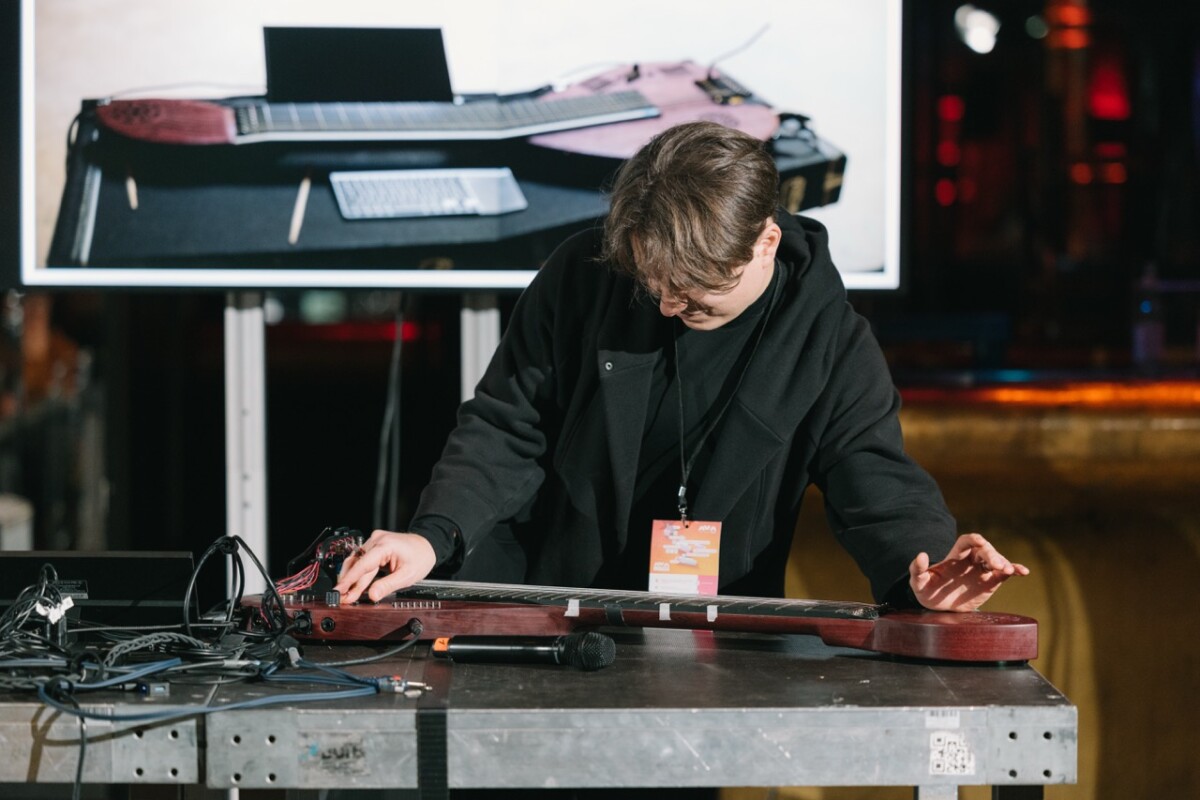
    Back in November I performed and presented the Sophtar at Most Wanted: Music Berlin (MW:M). The event that took place at the Kulturbrauerei, a multicultural centre created after the fall of the Berlin Wall in a converted 19th century brewery. My contribution was part of the Hybrid Music Lab, a platform within MW:M for exploring new forms of musical expression.

    It was a lovely, well-organised event, curated by Matthias Jung, whom I first met during the Embedding Algorithms Workshop. It was great to see fellow researchers and performers from the Intelligent Instruments Lab and the Wilding AI workshop again, meet new people and learn about their research work.

    I was particularly surprised by how much people enjoyed playing with and exploring the Sophtar for the first time. Some people sat at my booth playing the instrument for nearly an hour and afterwards shared their impressions with me enthusiastically. I honestly did not expect that. I designed the instrument for myself, not thinking too much about whether other people might find it appealing or not. Apparently several aspects of the instrument resonated with others, and that’s definitely a good thing.

    Here are some pictures from the event taken by Lisa Vlasenko.

  • Presenting at AIMC, Conference on AI Music Creativity

    Presenting at AIMC, Conference on AI Music Creativity

    Alexandre Saunier and I are presenting a paper co-authored with Maurice Jones about the behaviour generator based on large language models (LLMs) that we used during the Wilding AI workshop at MONOM, part of CTM Festival 2025. Some highlights of what we’re presenting:

    • LLM Behavior Generator that transforms textual prompts into expressive sound modulations and motions in space.
    • Chain of thoughts involving a “recipe” LLM cascading into a “code” LLM.
    • Max for Live implementation for artistic use in Ableton Live with immersive audio systems such as 4D SOUND.
    • Artistic experimentations and user feedbacks suggests such LLM-based system should be contextualized in the history of sound practices employing aleatoric, emergent, and open-ended strategies.

    Here are the title and abstract:

    Large Language Models to generate sonic behaviors: the case of Wilding AI in exploring creative co-agency

    Large Language Models (LLMs) and foundational models play a central role in multimodal text-to-sound systems, such as text-to-speech and text-to-music, as well as in recent musical agent systems designed to automate music production tasks. We explore an alternative approach that employs LLM-based sonic agents as spatial composition techniques. This method, emerging from the Wilding AI research-creation project, integrates LLMs into Max/MSP, Ableton Live, and spatial sound environments. LLMs are used to generate step-by-step sequences controlling spatial audio parameters, including sound motion in 3D space and other assignable sound properties.
    This paper details the artistic framework of Wilding AI, a LLM behavior generator, a live performance at the CTM Festival 2025, and discussions on composition, improvisation, time, and agency. Our work repositions LLMs as tools for shaping sonic experiences rather than merely generating finished audio material.

    Here is the full paper: https://zenodo.org/records/16946605

    Screenshots of the Max for Live interface of the Wilding AI LLM Behaviour Generator.

    This is one outcome of the collective research-creation lab Wilding AI.

    Members of the Wilding AI collective at Funkhaus Berlin during CTM 2025

  • TCP/Indeterminate Place quartet performs Reconciliation at Studio Acusticum

    TCP/Indeterminate Place quartet performs Reconciliation at Studio Acusticum

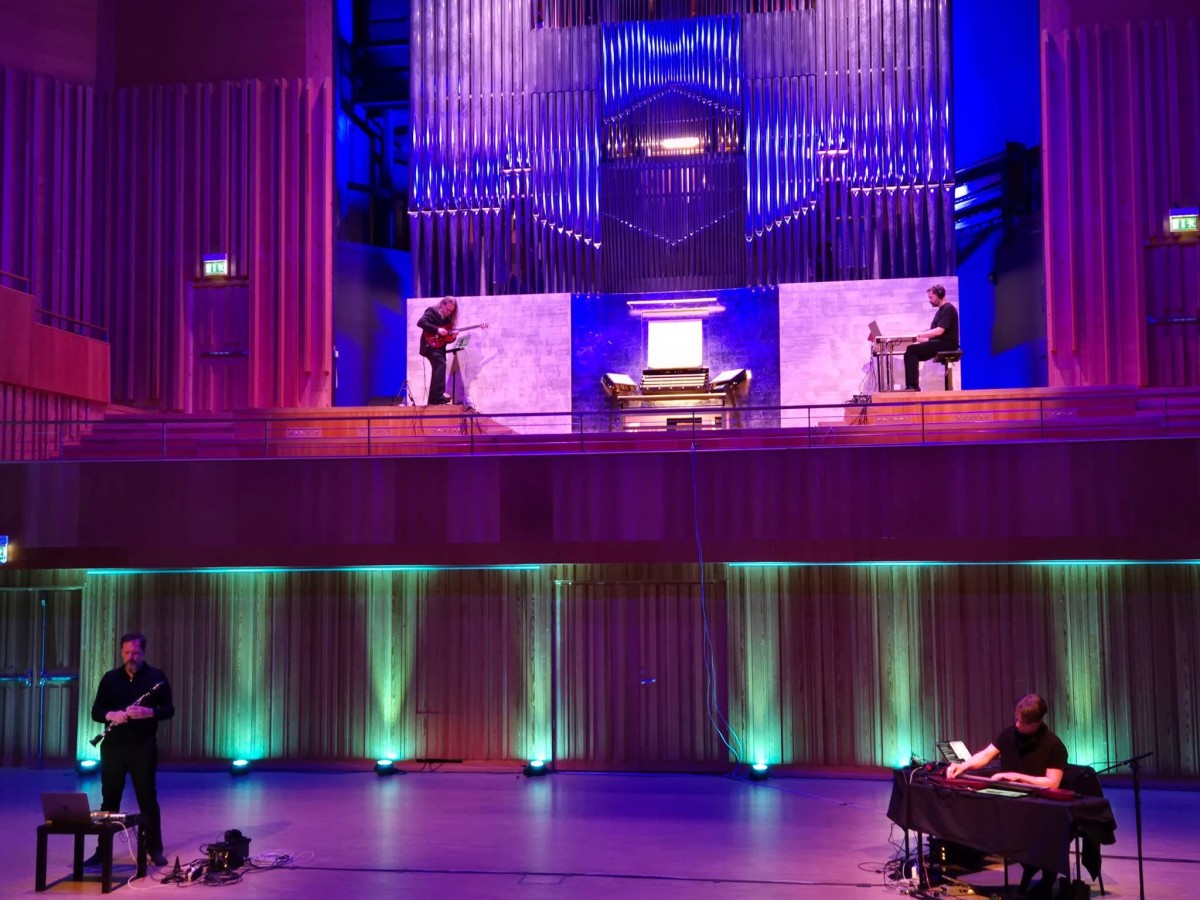
    On Monday 9 June 2025 the TCP/Indeterminate Place quartet performed Reconciliation, a piece we composed in 2024 for a special double duo telematic performance in which two of us performed at the Kapelle der Versöhnung in Berlin and the other two at the Orgelpark in Amsterdam. This time we were all at the Studio Acusticum main concert hall, playing our instruments and interacting with the massive Acusticum/University pipe organ in several ways. I experimented with the pressure aftertouch of the Sophtar as a way of adding and subtracting stops to the registration of the IV manual of the organ. Here is short snippet I recorded with my phone during sound check.

    TCP/Indeterminate Place is:
    Mattias Petersson: parsimonia, live coding, hyperorgan
    Stefan Östersjö: midi electric guitar, hyperorgan
    Robert Ek: augmented clarinet, hyperorgan
    Federico Visi: sophtar, hyperorgan

    Our performance was a prelude Mattias Petersson’s successful PhD defence titled “The Act of Patching” that took place the following day.

  • The Sophtar at the Guthman Musical Instrument Competition

    The Sophtar at the Guthman Musical Instrument Competition

    The Sophtar has been selected as one the ten finalists in this year’s Guthman Musical Instrument Competition.

    Together with Sukandar Kartadinata, we will bring the instrument to the Georgia Tech campus in Atlanta (US) to present it to the competition’s judges and participate in a public performance involving local Atlanta musicians.

    I designed the Sophtar and built it in collaboration with Kartadinata. At the Intelligent Instruments Lab, the Sophtar was extended with actuators, on-board DSP, and machine learning models to make it respond to the player in ways that are not easy to predict yet meaningful and inspiring.

    Read more about the Sophtar here and check out all the finalists in this year’s compeition here.

    The Sophtar has been developed with the support of the GEMM))) research cluster at Luleå University of Technology, the Intelligent Instruments Lab at University of Iceland, the European Research Council, the Swedish Research Council, the Boström Fund, and the Helge Ax:son Johnsons foundation.

  • Wilding AI Lab, CTM 2025

    Wilding AI Lab, CTM 2025

    Next week I will take part in the Wilding AI Lab:

    this four-day lab will assemble a group of participants selected via open call to learn about the application of generative AI in spatial audio, and collectively explore the wilder territories of AI. Shaped as a mix of theoretical and hands-on components, the lab runs 23 – 25 January, and culminates with a public presentation session Sunday 26 January.

    The lab will take place at MONOM, a unique performance venue and spatial audio studio housed at Funkhaus Berlin. It consists in a 3D array of omnidirectional speakers arranged on columns and subwoofers placed underneath the audience, beneath an acoustically transparent floor.

    I am pretty excited about experimenting with the Sophtar there, particularly given that each of its eight strings and the audio synthesis machine learning models can be routed to separate output channels, making it possible to place each sound source in a different point in space.

    I look forward to meeting the other participants in person. Engaging with a community of practitioners, share skills and ideas, and take part in an open critical discussion on AI- and data-driven tools is crucial to address the rapid changes affecting our cultural landscape. I believe it is also very important to open the process to the public in order to demystify the black boxes, promote critical thinking, spread knowledge, and offer new narratives, so I am excited at the prospect of an open lab on the fourth day. As in Maurice Jones’ words during our first collective Zoom meeting “the design of how we gather is essential.”

    Participants

    Hosts

  • Embedding Algorithms Workshop

    Embedding Algorithms Workshop

    EDIT: following the workshop, we’re now co-editing a thematic issue of Organised Sound on the topic. Here is the call.

    EDIT: here are some videos recorded during the event.

    The Embedding Algorithms Workshop is an informal meeting of researchers and practitioners working with embedded systems in the fields of musical instrument design, wearable computing, interaction design, and performing arts. During the workshop, the participants will show and discuss:

    • designing physical objects (instruments, wearables, and more) that incorporate some algorithmic process that is central to their function or behaviour;
    • designing and implementing embedded algorithms;
    • using/performing/practising with objects with embedded algorithms;
    • and more.

    Time: Friday, 26th July 2024, 10:00-18:00
    Place: Universität der Künste Berlin – Berlin Open Lab – Mixed Reality Space (aka BOL2) – Einsteinufer 43, 10587 Berlin.
    NB: There is a large construction site in front of Einsteinufer 43. Once you have found your way around it and entered the building, go past the reception and through the glass doors. Turn left at the end of the corridor and go past another set of glass doors. BOL 2 is at the very end of the long corridor you will find ahead of you, last door on the right.

    The event is open and free to attend. Please register here just so we can get a better idea of how many people to expect.
    More info: mail(at)federicovisi(dot)com

    Overall schedule:
    10:00 – 12:30: presentations/discussions (session 1)
    12:30 – 13:30: exhibitions introduction and lunch break
    13:30 – 16:00: presentations/discussions (session 2)
    16:00 – 16:30: coffee break, exhibitions
    16:30 – 18:00: performances and closing remarks

    Presenters

    (15 min + 10 min Q&A each, distributed in 2 x 2.5-hr sessions)

    In no particular order:

    Talks

    In no particular order:

    Alberto de Campo & Bruno Gola: “From intuitive playing to Absolute Relativity – How tiny twists open possibilities for Multi-Agent Collaborative performance”

    This talk discusses the sequence of small twists in the long-term development of the NTMI project that opened up new perspectives. These turning points include the idea of replacing analytical control with intuitive influence, opening the interface options from a single custom device to various common interfaces, the idea to enable these influence sources to work simultaneously. 
    The latest step, adapting the influence mechanisms to be consistently relative, creates further options for multi-agent performance, including networks of influence sources and destinations, which may extend to nonhuman actors. 

    Eliad Wagner: “Modular synthesisers as cybernetic objects in musical performance”

    This presentation (performance demonstration accompanied by discussion) is a result of an ongoing artistic research on the topic. Its focus is twofold: the material algorithms that govern the cybernetic machine behaviour (sound creation) and the human gestures (incl. the points of control that allow them) that facilitate form and meaning.
    Central to the examination is the embedding of patch algorithms within the modular synthesiser, an instrument that lacks established techniques, canon, or prescribed usage. Each such interaction with the synthesiser reinvents its structure and interface, resulting in a constant process of instrumental grammatization. In this context, improvisation emerges as a useful and even necessary method for responding to the uncertainty and unpredictability of the machine. In a sense, the embedded algorithm informs both counterpart behaviours – machine and human, and potentially transforms the identity of the human component- from control to participation.

    Echo Ho: “Can Ancient Qin Fingering Methods Inspire AI Engineering for New Musical Expressions?”

    This short presentation explores the convergence of ancient Chinese qin-fingering methods and modern AI/ML techniques. The PhD project “qintroNix” reinterprets historical qin learning methods for contemporary art and music. The qin, a seven-stringed instrument with a three-millennia history, uses classifiers inspired by natural phenomena to depict fingering techniques. These classifiers, representing animals and plants, serve as mnemonic devices and metaphorical maps, linking physical movements with musical expression and philosophical models.
    The project speculates on integrating these ancient techniques into modern AI/ML frameworks. Like ancient classifiers distilled natural phenomena into musical gestures, AI/ML algorithms extract and model features from large datasets. This parallel provides a framework for developing AI/ML systems with human-interpretable metaphors, enhancing pattern recognition and classification transparency.
    Exploring phenological phenomena in qin music fosters an ecological consciousness, connecting musicians with an other-than-human world. This entangled approach aligns with contemporary efforts to bridge organic and digital realms; combining archaic knowledge with contemporary technology can unlock new possibilities for imagination, innovation, and a more profound understanding of music’s role in our world.

    Viola Yip: “Liminal Lines” 

    In Viola Yip’s latest solo work “Liminal Lines”, she developed a solo performance with her self-built electromagnetic feedback dress. This feedback dress is made of non-insulated audio cables attached to a soft PVC fabric. These cables allow audio signals to pass through. The signal is first captured by an electromagnetic microphone, and then the captured signals pass through guitar pedals and a mixer, and eventually back to the dress to complete the feedback loop. Her body, when wearing the dress, facilitates a wide range of distances, pressures, and speeds through her physical engagement (touching, squeezing, stretching, etc.). These body-and-instrument interactions physically manipulate the interferences and modulations of the electromagnetic fields, which allow various complex sonorities to emerge and modulate over time.
    In this symposium, she develops a new lecture performance with this dress, in which she will dive into her journey with physical touch, materialities and spaces within and surrounding the wearable instrument and the performer’s body. 

    Andrew McPherson: “Of algorithms and apparatuses: entangled design of digital musical instruments”

    Digital musical instruments are often promoted for their ability to reconfigure relationships between actions and sounds, or for those relationships to incorporate forms of algorithmic behaviour. In this talk, I argue that these apparently unlimited possibilities actually obscure strong and deeply ingrained ideologies which lead to certain design patterns appearing repeatedly over the years. Some such ideological decisions include the reliance on spatial metaphors and unidirectional signal flow models, and the supposition that analytical representations about music can be inverted into levers of control for creating it. I will present some work-in-progress theorising an alternative view based on Karen Barad’s agential realism, particularly Barad’s notions of the apparatus and the agential cut. In this telling, algorithmic instruments are not merely measuring and manipulating stable pre-existing phenomena; they are actively bringing those phenomena into existence. On closer inspection, the boundaries between designer and artefact, instrument and player, materiality and discourse, are more fluid than they first appear, which offers an opening for new approaches to design of algorithmic tools within and beyond music.

    Nicola L. Hein: “Cybernetic listening and embodiment in human-machine improvisation”

    In this talk, I will show and discuss several pieces of mine which operate within the domain of human-machine improvisation using musical agent systems. The focus of this talk will be the changing parameters of cybernetic listening, interaction, and embodiment between human and machine performers. By using my own works, which employ purely software-based musical agents, visual projections and light, robots, and varying perceptual modalities of musical agents as a matrix of changing parameters of the situated human-machine interaction, I will argue for the importance of embodiment as a central concern in musical human-machine improvisation. The term cybernetic listening will help to further elaborate on the systemic components of musical performance and interaction with musical agent systems.

    Federico Visi: “The Sophtar: a networkable feedback string instrument with embedded machine learning”

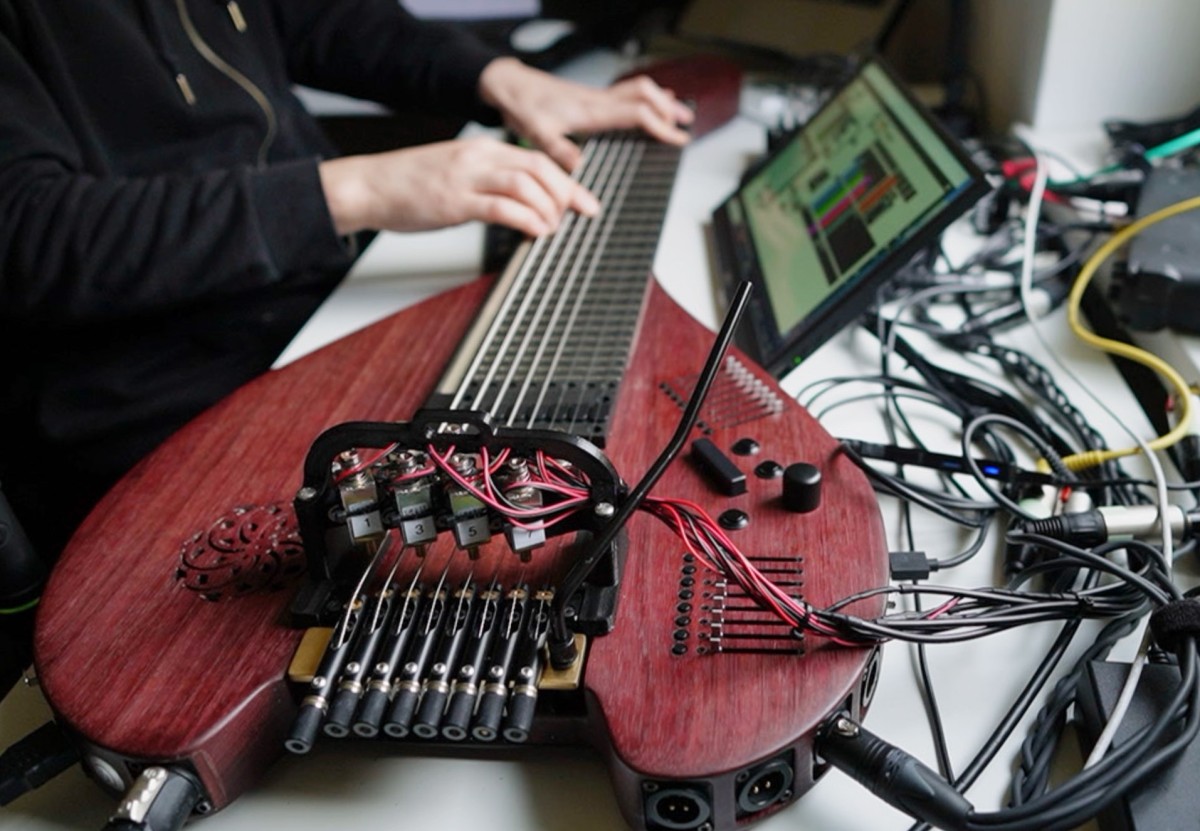
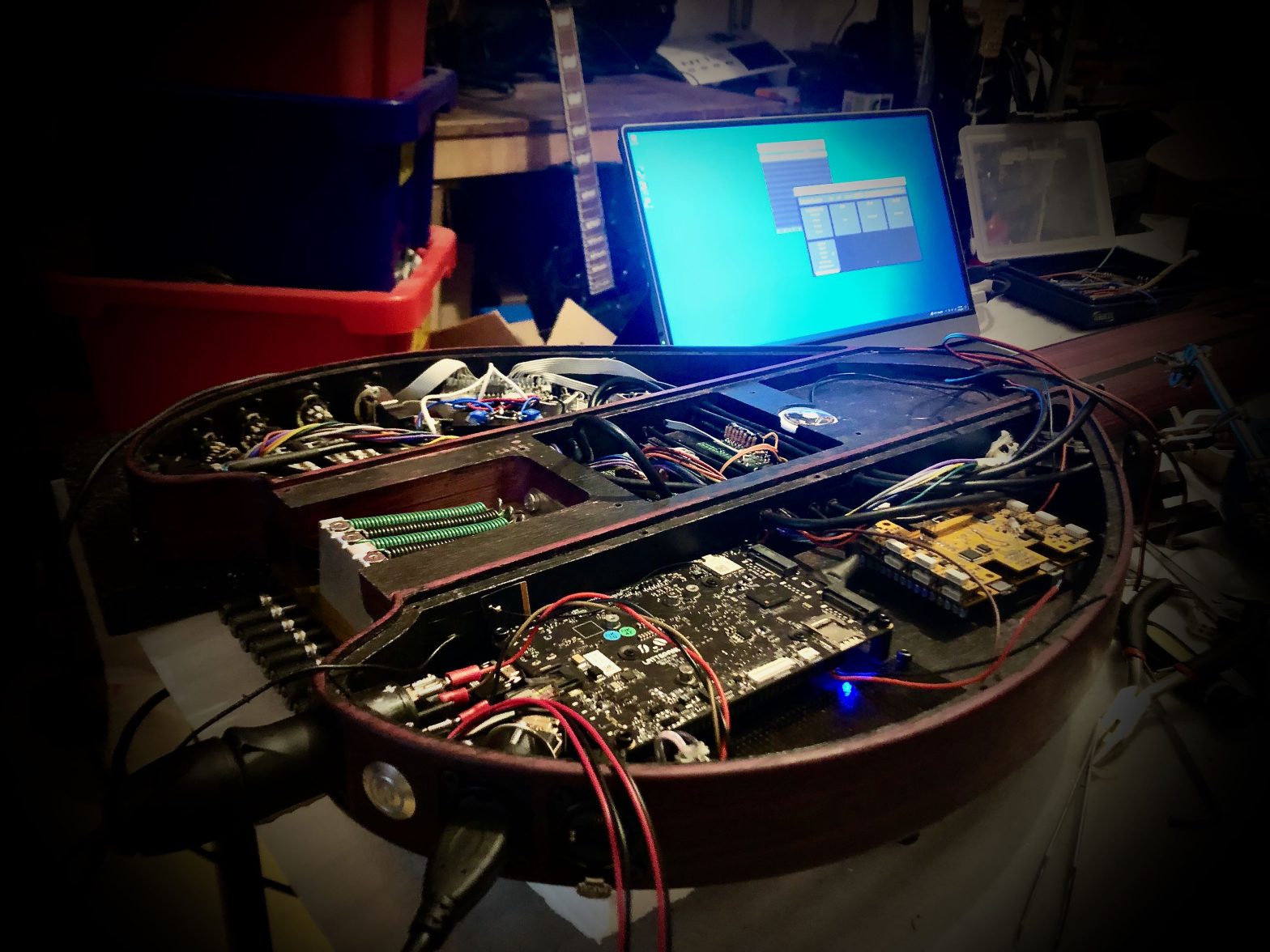
    The Sophtar is a tabletop string instrument with an embedded system for digital signal processing, networking, and machine learning. It features a pressure-sensitive fretted neck, two sound boxes, and controlled feedback capabilities by means of bespoke interface elements. The design of the instrument is informed by my practice with hyperorgan interaction in networked music performance. I discuss the motivations behind the development of the instrument and describe its structure, interface elements, and the hyperorgan and sound synthesis interactions approaches it implements. Finally, I reflect on the affordances of the Sophtar and the differences and similarities with other instruments and outline future developments and uses.

    Teresa Pelinski and Adam Pultz Melbye: “Building and performing with an ensemble of models”

    How can we then treat machine learning models as design material when building new musical instruments? Many of the tools available for embedding machine learning in musical practice have fixed model architectures, so that the practitioners’ involvement with the models is often limited to the training data. In this context, the design material appears to be the data. From a developer’s perspective, however, when training a model for a specific task, a ‘model’ does not refer to a single entity but to an ensemble instead: the architecture is trained varying the number of layers, blocks or embedding sizes (the hyperparameters), and training-specific parameters such as learning rate or dropout. 
    For the last month we have been working on a practice-based research project involving the FAAB (feedback-actuated augmented bass), the ai-mami system (AI-models as materials interface) and a modular synthesiser. In this talk, we will discuss our process when building this performance ensemble, our insights in using machine learning models as design material, and finally, the technical infrastructure of the project.

    John MacCallum: “OpenSoundControl Everywhere”

    In this talk/demo I will preview OSE, a lightweight, dynamic OpenSoundControl (OSC) server designed for rapid prototyping in heterogeneous environments. Since its development over 25 years ago, OSC has been a popular choice for those looking to expose software and hardware to dynamic control. OSC itself, however,
    is not dynamic—seamless integration of new nodes into an existing network is challenging, and OSC servers are not typically extensible at runtime. This lack of dynamism stands increasingly in the way of truly rapid prototyping in fields such as digital musical instrument design. OSE provides a solution to this challenge by implementing a general purpose OSC server that itself is an OSC server, allowing for dynamic control and configuration. I will discuss briefly some implications for design with such a system, the state of the current work, and its future.

    Exhibitions

    (the exhibitions will be briefly introduced right before the lunch break)

    • Zora Kutz and Stratos Bichakis: Beads Beats
    • Friederike Fröbel, Malte Bergmann: Student projects, MA Interface Cultures, Kunstuniversität Linz

    Zora Kutz & Stratos Bichakis: “Beads Beats”

    As one of the earliest forms of fabric decoration, found separately in cultures across the world, beading provides a rich history of techniques and materials that fit well with creating interactive textiles. Sensitive to touch and pressure, capacitive sensing allows for a range of input that can then be used for a variety of applications. In this project, we wish to create an artefact not unlike a musical instrument, used to control both synthetic soundscapes and the spatialisation of audio material. Along the process we are documenting findings for both the types of interaction we are researching, as well as the material and construction specifications.

    Friederike Fröbel & Malte Bergmann: “Experiments with textile interfaces and found sounds”

    This exhibition presents projects that explore meaningful sound interactions through textile-tangible interfaces using digital sound processing techniques. They were developed in two courses of the Masters Programme Interface Cultures at the University of Art and Industrial Design in Linz, Austria. The annual course explores the relationship between technology, fashion, craft and design with a particular focus on the idea of dynamic surfaces and soft circuits and how these can be realised through various textile processing techniques such as knitting, weaving, embroidery and many more. The course consisted of experimenting and exploring textile processing techniques using capacitive sensors and designing novel interaction prototypes with soft interfaces. Students worked on projects using Bela Mini, Trill Craft and Pure Data. Each student brought a personal field recording and a piece of clothing or textile to which they had a particular attachment. The materials students brought ranged from fish leather and stomach rumbles to suitcases and the rattling sounds of railway bridges. These materials would be ‘upcycled’ and combined as part of the group work, where they would be collectively combined to use soft textile sensing to generate expressive and playful ways of using clothing as a sound interface.

    Performances

    (~1 hour in total at the end of the workshop)

    • Echo Ho and Alberto de Campo
    • Adam Pultz Melbye and Teresa Pelinski
    • Eliad Wagner
    • Federico Visi
    • Absolute Relativity – flatcat, Kraken, nUFO, and more, group and audience welcome to play
    • Nicola Hein