I recently got back from two very inspiring weeks at the Centre for the Advanced Study of Collective Behaviour (CASCB) in Konstanz. There, I did the first artistic residency of my Musikfonds AI Scholarship project Co-improvising with the Non-human. I chose to visit this interdisciplinary research cluster in order to broaden my perspective on what intelligent behaviour is, and find new sources of inspiration for creating algorithmic agents for musical improvisation.
I am particularly interested in how groups of non-human beings find ways to organise and dynamically adapt to unforeseen circumstances. What emerges from such group behaviours is more than the sum of its parts: seemingly simple individual strategies become beautifully complex, as swarm dynamics come into play. I find this inspiring in the context of musical co-improvisation, where the interplay between musicians may also result in something difficult to predict that is more than the sum of its parts.
During my stay in Konstanz I learnt more about how fireflies synchronise, how bats use ultrasound for echolocation, the vocal repertoire of meerkats and the meaning of their many calls, how bees use sound to inform others in the hive of potential dangers, how locusts change their behavioural patterns when they join a swarm, and more.


The research environment at CASCB is very interdisciplinary by design. Biologists, ethologists, neuroscientists, roboticists, and computer scientists often sit in the same room contributing to the same project. Coffee breaks become opportunities for very interesting casual conversations, where one can learn more about things they didn’t even know they were interested in.
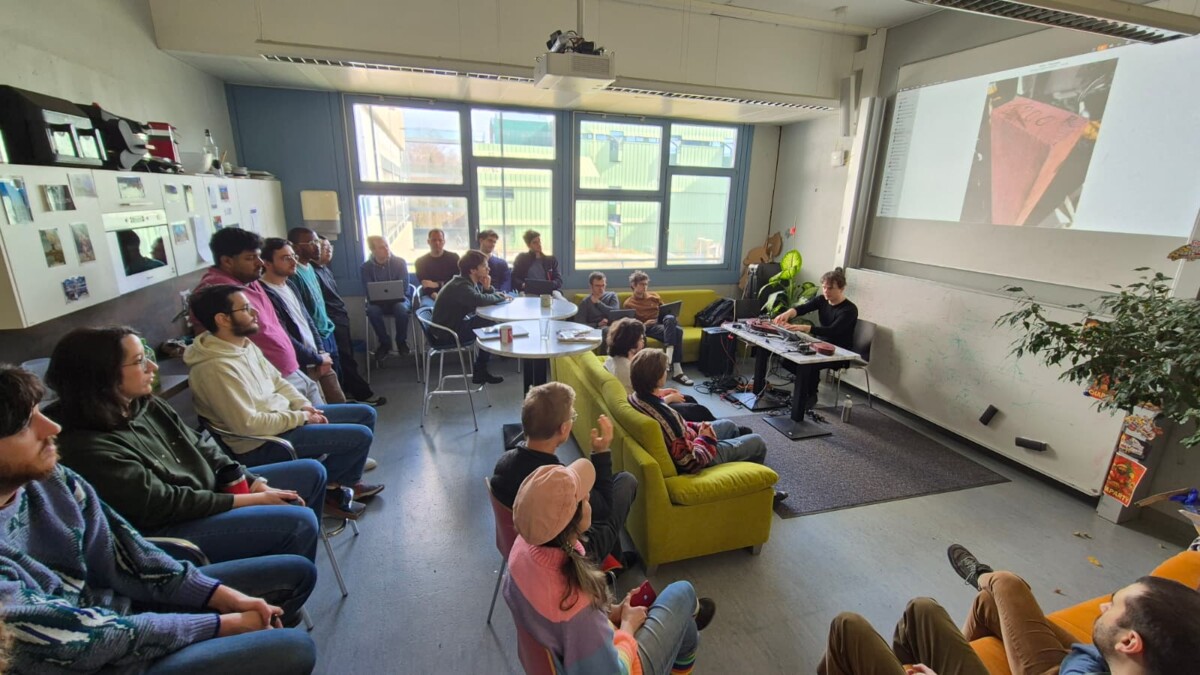
I presented my work in a seminar, part of a series organised by Andreagiovanni Reina, the Principal Investigator of the Group Intelligence and self-Organisation Lab (GIO Lab). The turn out and interest surprised me, particularly given that I come from other research domains. The questions and conversations that followed were also very stimulating. A few days later I performed with the Sophtar at a Friday evening social event at the Max Planck Institute of Animal Behavior and that was a lot of fun.


I visited many laboratories during my stay, and was impressed by the variety and scale of the experiments going on at CASCB. I saw virtual reality rigs for insects, groups of robots using echolocation inspired by bats, tools capable of capturing the physiological signals of bees and microscopic fish, among other things. I even had the chance to go on a mountain hike as well as on a “bat walk.” That is an evening walk in the forest with bat detectors, devices that capture the ultrasonic calls of bats and transpose them to a frequency range that humans can hear in real time.

I am very grateful to Andreagiovanni Reina for hosting me in his group and introducing me to many of the people working at CASCB. I am also very grateful to all the researchers I met during my stay who very generously took the time to show me their work and answer my questions.
The next residency of the project will take place at IRCAM, where I’ll work with the REACH team at the STMS Lab to embed Somax2—an AI-based multi-agent system for human–machine co-improvisation—into the Sophtar.