Back in April I did the second artistic research residency of the Co-Improvising with the Non-human project, this time at IRCAM. During the residency period I worked closely with Marco Fiorini of the REACH team to integrate Somax2 — an AI-based multi-agent system for human–machine co-improvisation — into my custom instrument, the Sophtar. Here is a Sophtar + Somax2 improvisation I did the night before leaving Paris.
What’s going on in the video:
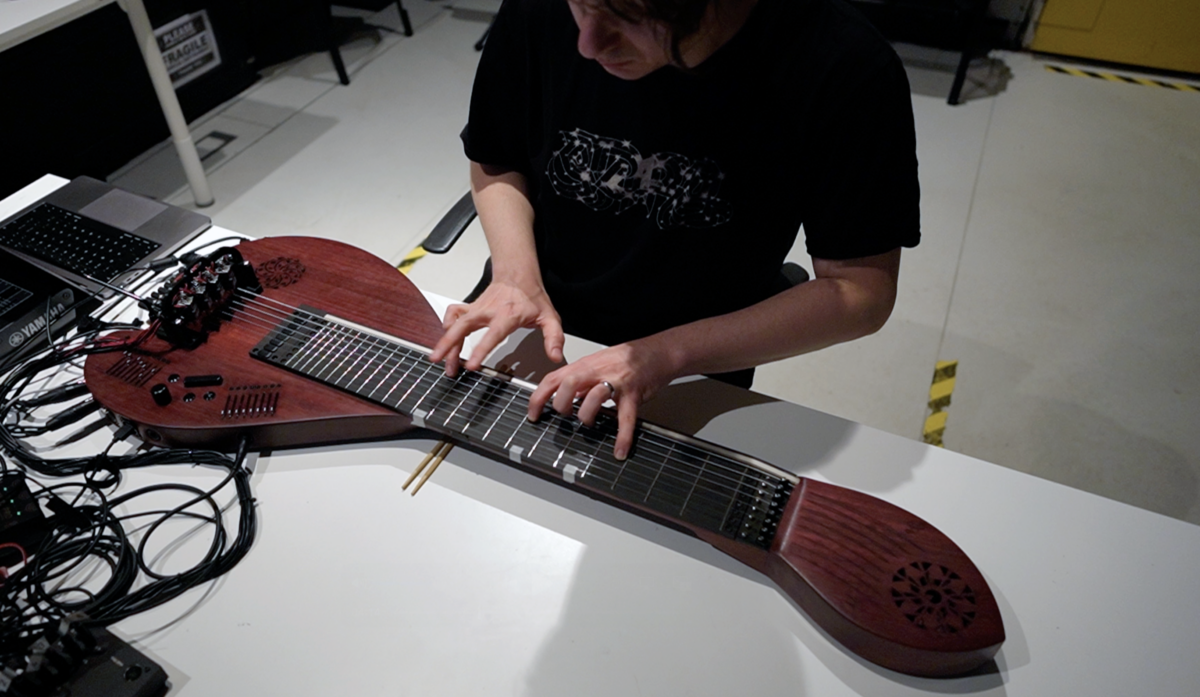
The Sophtar is a feedback instrument, there is a transducer inside the head sound box. Somax2 – a multiagent system for human-machine co-improvisation – runs on the embedded computer responds to the human player by evoking structures of the musical data it is trained on. It tunes the bandpass filters in the electroacoustic feedback loop in response to how the bottom three strings are played. The model responds with pitches and onsets following a local stylistic knowledge space. These output pitches are mapped to 12 harmonics, and onsets are used to activate the solenoids and trigger amplitude envelopes that shape the electroacoustic feedback of the top five strings. The result is an encounter between the human player and the ghostly traces of the musics that formed the training dataset. The strings effectively become a place of contact between human, machine players, and the musical knowledge they encode.


I have chosen to collaborate with the REACH group at IRCAM because their work is currently at the forefront of the research on using algorithms for human-machine co-creativity. REACH is a research project funded by the European Research Council and led by Gérard Assayag, and IRCAM is one of the leading music and technology research centres in the world. Their research work aims at understanding, modeling, and developing musical co-creativity between humans and machines through improvised interactions. Researchers at REACH study shared musicianship occurring at the intersection of the physical and digital spheres and have produced models and tools as vehicles to better understand human creativity in a context where it becomes more and more intertwined with computation.
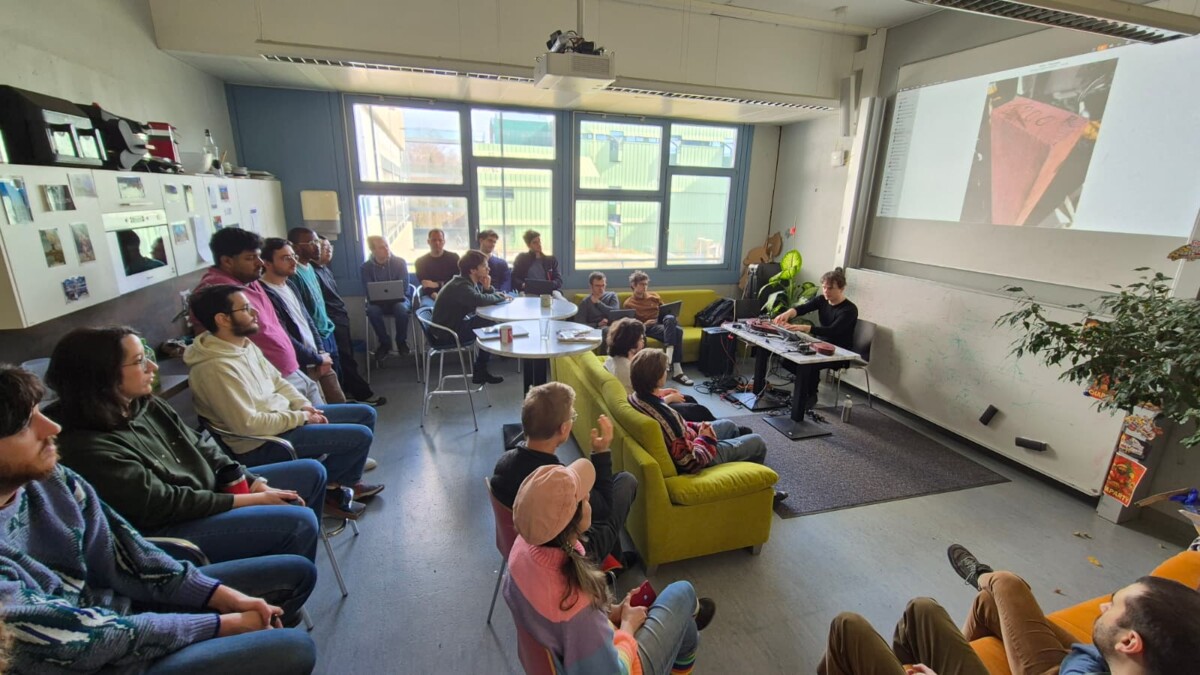
The residency period was very productive. I had access to IRCAM’s Studio 6 for several days, I successfully embedded Somax2 in the Sophtar and refined the algorithm that filters strings harmonics in the feedback loop in order to make Somax2 interact with it more expressively. At the end of the two weeks, I had the opportunity to perform and present my work to other researchers and composers at IRCAM. The session lead to very interesting exchanges with other musicians and researchers, including a hands-on session with Alois Cerbu shortly after to experiment with a frequency-domain saturator in the Sophtar feedback loop.


I already made use of the results of the residency in a recent performance with Ensemble KNM in Berlin (more info here: The Nine Lives of Zosimos – Ensemble KNM Berlin) and will use the system also in an upcoming performance at the International Conference on New Interfaces for Musical Expression (NIME) in London. I will play on Thursday 25 June at 19:00 at Rich Mix in Shoreditch. I think the line up of the evening is really cool, and the programme of the whole conference also looks very promising.
Grateful to Gérard Assayag, Marco Fiorini (who also kindly took some of the photos in this post), and Vasiliki Zachari for hosting me at IRCAM. Big thanks to Musikfonds and Culture Moves Europe for supporting my residency.
Read more: