Category: Research

  • SloMo study #2

    SloMo study #2

    This piece was performed at NIME 2018 (both at the Virginia Tech’s Moss Arts Center and at the NIME performance night organised by University of Virginia in Charlottesville) and at MOCO 2018, held at InfoMus – Casa Paganini.

    I composed SloMo study #2 to explore the use of slow and microscopic body movements in electronic music performance, and the role of rhythmic visual cues and breathing in the perception of movement and time. To do so, I used wearable sensors (the EMG sensors and IMUs found in Myo armbands), variable-frequency stroboscopic lights, an electronic stethoscope, and a body-worn camera for face tracking.

    Here is a short video excerpt that I used to accompany my NIME and MOCO submissions. Unfortunately the effects of slowly changing the frequency of the strobes cannot be captured in videos with standard frame rates.

    Speaking of NIME, I’m going to be a Music co-chair for NIME 2019 and I’m really looking forward to seeing what NIME artists have come up with this year.


  • New modosc objects for EMG & MoCap processing in Max

    New modosc objects for EMG & MoCap processing in Max

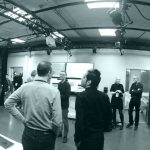
    During November and December 2018, I had the opportunity to spend 5 weeks as a visiting researcher at RITMO Centre for Interdisciplinary Studies in Rhythm, Time and Motion, an amazing centre of excellence recently inaugurated at the University of Oslo. In mid November, at the beginning of my stay, Luke Dahl and I presented modosc, our Max library for real time motion capture analysis to the attendees of the RITMO International Motion Capture Workshop. The library is the results of a collaboration between Luke and myself, and has been presented at various conferences in 2018, including NIME1 (paper) , and MOCO2 (paper).

    While in Oslo, I had the chance to spend time in the RITMO Motion Capture lab and use their Delsys Trigno wireless EMG system synchronised with their Qualisys cameras. With that gear, I coded three new modosc objects for real-time processing of EMG signals synchronised with MoCap:

    • mo.qtmSig: binds data from QTM analog boards to new signal addresses in the modosc namespace (under /modosc/signals);
    • mo.zcr: calculates the zero crossing rate of a signal (useful feature for classification tasks);
    • mo.tkeo: calculates the Teager-Kaiser energy-tracking operator (TKEO) of a signal (useful for onset detection and other things, to learn more check out Eivind Kvedalen’s PhD thesis: http://folk.uio.no/eivindkv/ek-thesis-2003-05-12-final-2.pdf). I got the idea of implementing this interesting feature from Geert Roks, a student at Goldsmiths University of London currently collaborating with Prof Atau Tanaka.

    Here are some video tutorials to get you started with modosc.

  • modosc: Mocap & Max video tutorials

    modosc: Mocap & Max video tutorials

    These are some introductory video tutorials about processing motion capture data in real time in Max using the modosc library.

    Modosc is a set of Max abstractions designed for computing motion descriptors from raw motion capture data in real time.


  • Building a swarm poly synth using Max 8 new MC objects

    Building a swarm poly synth using Max 8 new MC objects

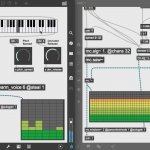
    I just downloaded the new Max 8 and here is a simple synth I built using the new MC (multichannel) objects. Each voice has 32 sawtooth oscillators, so with 6-voice polyphony you can get up to 192 oscillators playing at the same time. The dials control pitch spread and “deviated” release (meaning that each oscillator inside each voice will have a slightly different release time).

    Since few people on social media asked me to share the patch, I made it available for download here. EDIT: I moved the files to GitHub: https://github.com/federicoVisi/max_mc_swarm_polysynth

    NOTE: the patch is a quick and dirty experiment I did to try out the sound synthesis capabilities of the MC objects in Max 8. It is not a finished instrument and has some inconsistencies that should be fixed. You’re very welcome to edit the patch and get in touch to share ideas, although be aware that I might not have the time to provide technical support.

  • Testing the XTH Sense with Physical Models and Machine Learning

    Testing the XTH Sense with Physical Models and Machine Learning

    I recently had the chance to play with a prototype version of the new XTH Sense. I met up with Marco Donnarumma and Balandino Di Donato at Integra Lab in Birmingham and we spent a couple of days experimenting with this interesting and yet unreleased device. It is a small, wireless, wearable unit that comprises a Mechanomyogram (MMG) sensor for capturing the sounds produced by muscular activity and a 9DoF IMU unit, which returns various motion features, such as acceleration, angular velocity, and orientation.

    I had already been working with 9DoF IMUs data during my research collaboration at NYU Steinhardt in New York and for previous performances, so I knew what to I could expect in that department. However, one of the main peculiarities of the XTH Sense is the MMG sensor. While in New York, I had worked with Thalmic Labs’ Myo, which employs Electromyogram (EMG) for muscle sensing. I won’t go too deep into the technical differences between MMG and EMG, suffice it to say that EMG senses the electrical impulses sent by the brain to cause muscle contraction, while MMG consists of sounds that your muscles produce during contraction and extension[ref]If you want to learn more, Marco covered these topics thoroughly in this article written with Baptiste Caramiaux and Atau Tanaka, plus here is another article that compares the two technologies from a biomedical point of view.[/ref].  In terms of expressive interaction, what I find interesting about the MMG sensor of the XTH Sense is the distinctive way it responds to movements and gestures. Unlike EMG, the control signals obtained from the XTH Sense peak at movement onsets and remain relatively low if you keep your muscles contracted. This is neither better nor worse than EMG, it’s different.

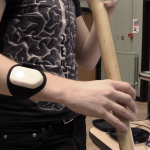
    While adapting my code, I started noticing how the response of the XTH Sense made me interact differently with the machine learning and physical modelling patches I had previously built using the Myo. I guess with a fair deal of signal processing I could make the two devices behave in a virtually similar way, but this in my opinion would be rather pointless. One of the exciting things about having to deal with a new device is to embrace its interface idiosyncrasies and explore their expressive potential. As a simple example, in the physical modelling patch I built for the rain stick demo we filmed in Birmingham, the amount excitation sent to the model depended on one of the MMG control features. Had I used EMG I would have obtained a steady excitation signal by firmly squeezing the stick, while the response of the MMG required me to perform a more iterative gesture — like repeatedly tapping my fingers on the stick — if I wanted to obtained a louder sound. This somehow reminded me of the gestures involved in playing a wind instruments and this idea influenced the whole interaction design I eventually implemented.

    I will soon be back in New York for a workshop and a performance at Harvestworks on May 8th, where I’ll show some of the tools and methodologies I use in my research and practice, including those I experimented with playing with the new XTH Sense for the first time. If you’re in the area and want to attend register here or if you just want to know more about it drop me a line.