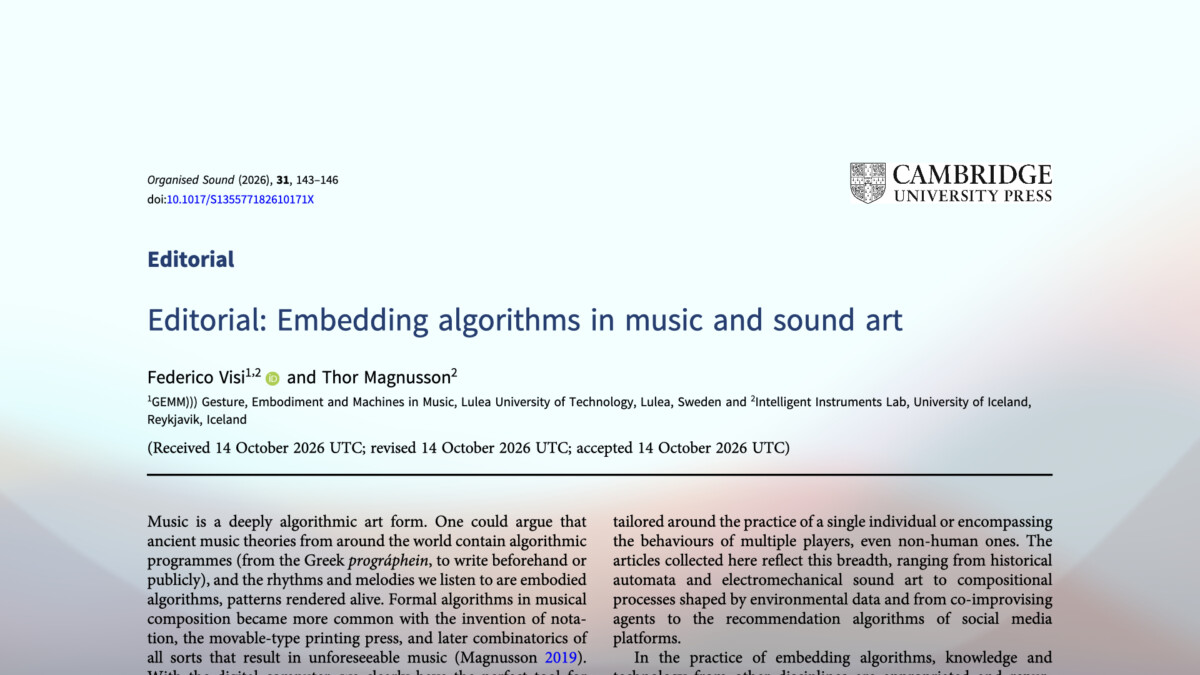
The Organised Sound thematic issue on Embedding Algorithms in Music and Sound Art, co-edited by Thor Magnusson and me, is now out. Most of the articles are open access, meaning they can be read for free.
The issue opens with our editorial,1 followed by 17 articles on how algorithms are built into the instruments, tools and compositional processes of music and sound art. The range is wide. Some articles go back to ancient automata and nineteenth-century musical devices, showing that embedding algorithms in musical tools is a practice much older than computers. Others look at electromechanical sound art, the politics of commercial generative AI, or at performing with “black box” instruments that can’t be fully understood or controlled. There are articles on a multi-agent autonomous looper trained on annotated co-performances and on embodied algorithms in vocal performance. One proposes emotional inference as a dramaturgical tool in live performance, another treats Instagram’s algorithm as a member of a performance assemblage, and several look beyond the human, towards animals and living environments.
To be clear: this is not an issue about typing prompts into Suno or Udio. As we explain in the editorial, our question is quite different. We are interested in how artists take algorithms (machine learning, but also analogue circuits, sensors, data and artificial life) and make them part of their instruments and practices. Often they train models on their own small datasets rather than relying on the extractive logic of commercial big-data platforms. One article in the issue, by Misagh Azimi and Mo H. Zareei, takes on commercial GenAI directly. The rest of the issue offers a sense of what else is possible.
The issue is the result of a rather long process, more than two years. It started with the first Embedding Algorithms workshop at the Berlin Open Lab in July 2024, an informal gathering of people working with embedded systems in instrument design, wearables and performance. Several of the workshop’s presenters went on to contribute to the issue. The workshop led to the idea of editing a thematic issue, which I proposed to Thor during my research postdoc at the Intelligent Instruments Lab in Reykjavík. The circle closed this October with Embedding Algorithms 2, which I organised at UdK Medienhaus in Berlin as part of my project Co-improvising with the Non-human.
We were told this is one of the thickest thematic issues Organised Sound has ever published, and a lot of human labour went into it. Thanks to Thor, to editor Leigh Landy and associate editor James Andean for their guidance and patience, to the roughly 60 peer reviewers who gave their time and expertise, and above all to the authors for their work.
If you’re wondering where to start, the editorial is meant as a gateway into the issue. It gives a short overview of every article, grouped by recurring threads: historical mechanisms, politics and ethics, opacity, distributed agency, and practices that reach beyond the human. We close the editorial on the idea that intelligent instruments ask practitioners to take responsibility for the data, models and values they embody, and that these questions are best kept open through experimental practice.
Enjoy the read!
- In case the editorial is not fully accessible on the journal’s website you can download the accepted manuscript here.